How to Use Urban Noir Lighting in Your Figure Drawing Practice
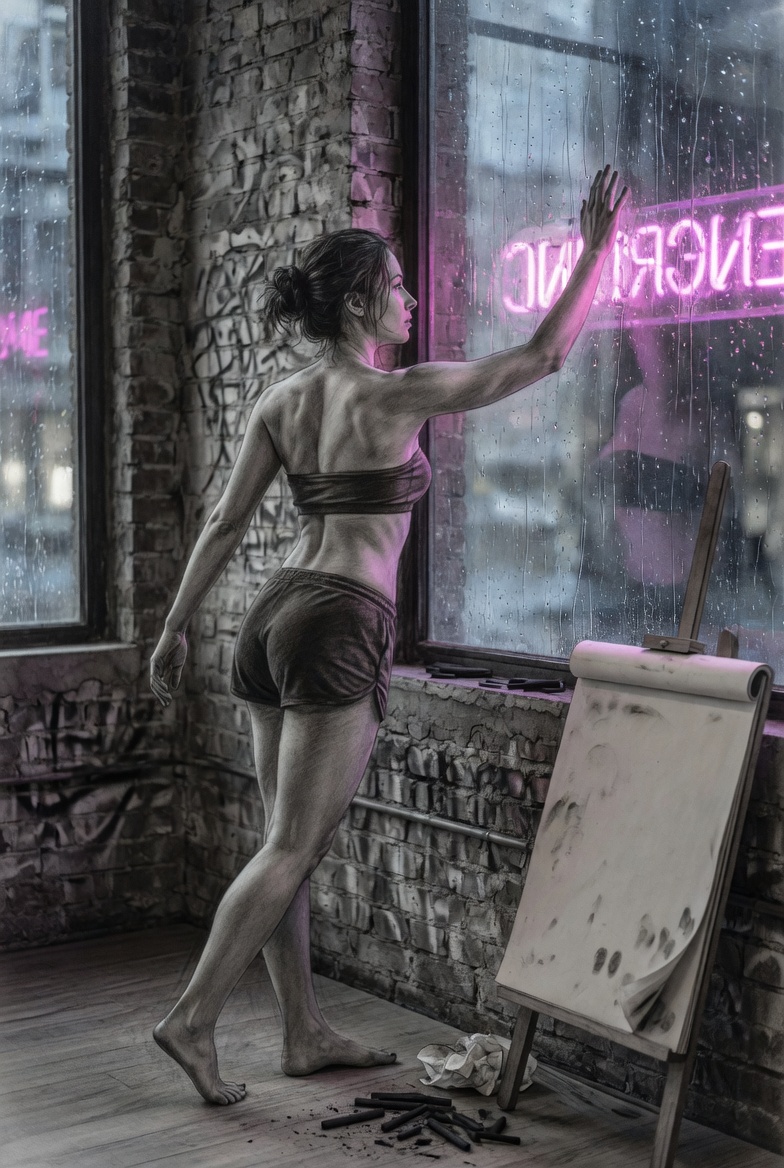


You’ve drawn the figure a hundred times under soft studio light — the same neutral backdrop, the same predictable shadows. It works, but it doesn’t move you anymore. Now imagine placing that same pose inside a rain-soaked warehouse at midnight, neon bleeding through a wet window, and suddenly the whole exercise feels electric again. That’s the power of borrowing atmosphere from unexpected places.
Why Noir Lighting Transforms Figure Study
Classical figure drawing has always been about understanding form through light and shadow. The academic tradition teaches you to model volume with careful gradations — but it rarely pushes you toward dramatic extremes. Urban noir lighting does exactly that. When your light source is a single industrial pendant or the distant glow of a city street, you’re forced to make bold decisions. Entire planes of the body disappear into darkness while a rim of light defines the edge of a shoulder or the curve of a spine. This isn’t just stylistic flair — it’s a training ground for understanding value hierarchy. You learn which details to sacrifice and which to protect. Artists like Edward Hopper understood this intuitively: place the human figure in architectural tension, and viewers can’t look away. Your charcoal stick becomes a storytelling tool, not just a rendering instrument.
Practical Tips for Setting Up a Noir Figure Session
You don’t need an abandoned warehouse. A single clamp light in a dim room gets you most of the way there. Position it high and to one side, angled steeply downward so it creates deep shadows under the brow, chin, and bent limbs. If you want that neon color accent, a cheap LED strip in magenta or cyan taped behind the model adds a gorgeous rim light that photographs beautifully and translates surprisingly well into colored charcoal or pastel over a graphite base. Ask your model to interact with the environment — a hand pressed against glass, a lean against a doorframe — because noir thrives on tension between the body and its surroundings. Shoot reference photos with your phone first so you can study the shadow map before committing to a long drawing. Pay attention to reflected light bouncing off floors and walls; those subtle warm or cool shifts in the shadow areas are what separate a flat drawing from one that breathes.
Making This Approach Your Own
The beauty of combining classical figure work with atmospheric lighting is that it invites your personal narrative into the drawing. Maybe you’re drawn to fog and winter streetlight rather than neon — that shifts your palette toward muted ochres and blue-grays. Maybe you prefer a seated pose with dramatic foreshortening instead of a standing contrapposto. The academic foundation gives you the anatomy; the noir environment gives you the emotion. Experiment with mixed media: start in graphite for the figure, then use ink wash for the deep architectural shadows. Let the environment be loose while the figure stays precise. That contrast in rendering style mirrors the contrast in your lighting and keeps the viewer’s eye anchored on the form.
If you want to generate visual references like these to study from — different poses, lighting setups, and moods on demand — ruke.online has AI tools that make it incredibly easy, no design skills needed. It’s a fast way to build a reference library tailored to exactly the kind of figure work you want to practice.